
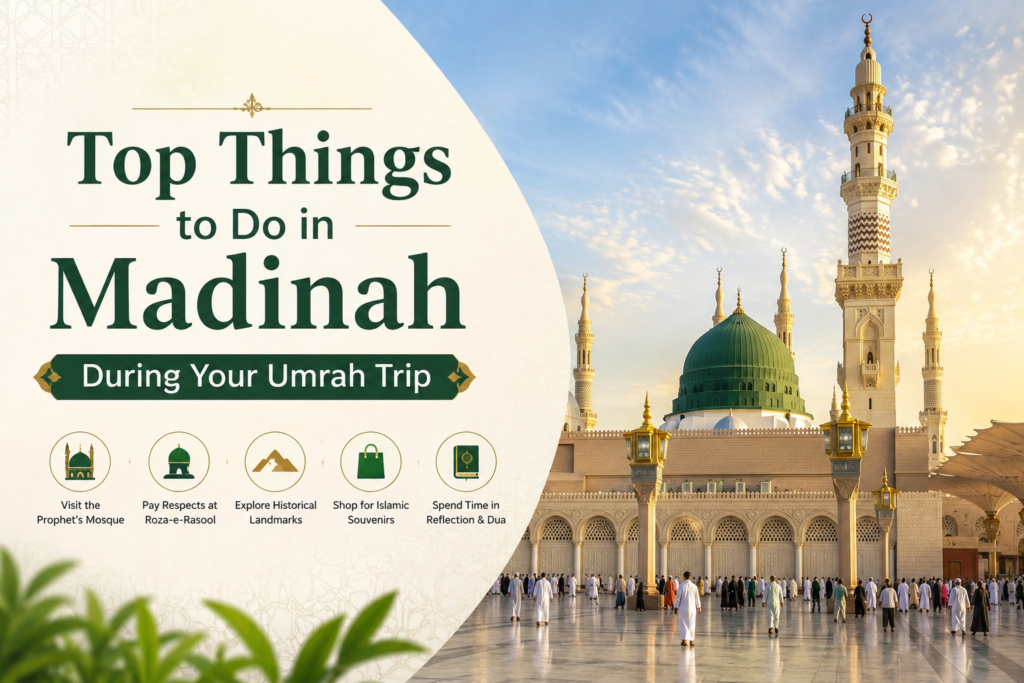
A visit to Madinah during the Umrah journey is one of the amazing experiences a Muslim can have. While Makkah is the heart of the pilgrimage, Madinah offers a serene and deeply spiritual atmosphere that touches the soul in a quiet and unforgettable way. The city of Prophet PBUH is alive with history, devotion, and warmth. Its streets carry a peace that invites reflection and connection. There are so many things to do in Madinah during Umrah.
From the majestic Al-Masjid Nabawi to the historic lanes where the Prophet PBUH walked, every corner of Madinah tells a story. You will feel a profound energy of centuries of faith and create memories that linger long after you return home. Madinah has vibrant markets and delicious local cuisines that welcome people and add life to a pilgrim’s holy journey. In this blog, we will learn some of the practical tips and insights to ensure your time in the city is not only spiritually fulfilling but also meaningful.
Is Visiting Madinah Part of Umrah?
This is one of the most common questions that not only the UK Muslims but Muslims all around the world have. A visit to Madinah is not an obligatory component of Umrah. The Umrah rituals are Tawaf, Sa’i, and shaving or trimming hair, which are performed entirely in Makkah. Madinah visit may not be a part of Umrah, but it brings a special blend of spiritual significance to your whole journey.
Ziyarah in Madinah allows a Muslim to experience Islamic history on a personal level. As pilgrims come to know the background of Madinah’s Islamic sites, their experience becomes thoughtful rather than just a quick ticking off of places. Almost every Umrah travel agency gives all-inclusive Umrah packages with 3 to 4 nights’ stay in Madinah. This gives a pilgrim enough time to pray in Masjid an-Nabawi across multiple prayer times. A pilgrim can complete his or her ziyarats in the peaceful city of the Prophet PBUH.
What Is Ziyarat?
Before moving ahead, the first thing that a pilgrim may need to know is the actual concept of Ziyarat. Special first-time pilgrims from the UK may not be familiar with this term. Ziyarat in Madinah refers to visits to places that are directly connected to the life of the Prophet Muhammad PBUH, his family (Ahl al-Bayt), his companions (Sahabah), and the major events that shaped early Islamic history.
Islamic scholars agree that Ziyarat is a recommended means, it is Mustahabb, when performed while maintaining pure Tawheed. Pilgrims do not ask the dead for help, nor seek blessings from structures. Instead, they make dua to Allah alone while reflecting on the sacrifices and lessons associated with each location. Ziyarat is not just about sightseeing; it is a walk through history with your heart. Every side you visit during your trip to Madinah, you will experience Islam’s history to its fullest.
The Must-Do Things in Madinah During Umrah
Madinah is the heart of peace and reflection during your Umrah journey. This place offers moments that go far beyond rituals. You can pray at Al-Masjid an-Nabawi, visit historic sites, and get a rich spiritual experience. During your ziyarat in Madinah, every step feels meaningful. Before heading to your Umrah journey, make sure that you have not only an Umrah preparation checklist but also a checklist of important things that you can do in Madinah. Such as:
Pray at Masjid an-Nabawi
The Prophet’s mosque is a centerpiece of any Madinah visit without any question. The second holiest site in Islam, after Masjid al-Haram, is Masjid al-Nabawi. Masjid al-Nabawi was built by the Prophet PBUH himself and includes two main places:
- Garden of Paradise
- The Prophet’s PBUH grave
Prayer in Masjid al-Nabawi carries immense virtue as one prayer here is equal to one thousand prayers elsewhere, except Masjid al-Haram. Within the mosque lies the Sacred Chamber, which has the resting place of the Prophet PBUH, along with Abu Bakr and Umar (RA). You can pray five daily prayers during your stay in this mosque.
Pray as many of the five daily prayers here as you can. The atmosphere in the early hours before Fajr is something pilgrims remember for the rest of their lives. At this time, the marble courtyard is cool and quiet, which gives a serene and spiritual feeling.
As per the latest updates of Umrah by the Ministry of Hajj and Umrah in Saudi Arabia, access to the Rawdah Mubarak now operates through a booking system via the Nusuk App. The allocation of Rawdah permits is mainly through this system. This makes it easy for the pilgrims to manage their visits to the Rawdah and allows the administration to easily manage the crowd. As slots fill up quickly during the peak season, make sure to book your slot in advance. You can read our “How to Perform Umrah Step by Step: A Complete Guide for UK Pilgrims” to better understand the whole Umrah process and the importance of the Nusuk app.
Offer Salawat at the Roza-e-Rasool
The visit to the Roza-e-Rasool is often the most emotional and significant moment of the Umrah journey. It is not only the Prophet’s PBUH final resting place, but it is also the beloved place of the Prophet. It is a place where the Prophet has spent a large part of his life delivering the message of Islam. When a pilgrim stands before the Prophet’s PBUH resting place, they should offer salah with peace and full presence of heart. This is not a tourism attraction, but a sacred encounter of Muslims where they have felt closest to the Prophet PBUH.
Pray in the Rawdah al-Sharifah
The Rawdah is a blessed area within Masjid an-Nabawi, located between the Prophet Muhammad PBUH’s Mimbar and his grave. It is a place that is called a part of the gardens of paradise. Pilgrims try to spend as much time here as possible. They offer their supplications and seek closeness to Allah. In Rawdah, you will find a spirituality that fills the atmosphere and makes it essential for a pilgrim to visit Madinah.
It is narrated that the Prophet PBUH said:
“Between my house and my pulpit is a garden from the gardens of Paradise.”
(Bukhari & Muslim)
This is the reason why praying two rakaats in the Rawdah is considered an enormous, blessed salat. Book your slot using the Nusuk app and make the most out of your visit.
Visit Quba Mosque
The Masjid-e-Quba is regarded as the first mosque ever built in Islam. The Prophet PBUH used to visit this mosque every Saturday to pray two rakaats. When you offer prayer and complete customs here, you will gain rewards equal to those of an Umrah.
The hadith that underpins this is clear:
“Whoever purifies himself in his house and comes to Masjid Quba and offers two rak’ahs therein will have the reward of an Umrah.”
(Ibn Majah 1412)
This mosque is about 3.5 to 4 kilometres heading south of Masjid Nabawi. Most pilgrims take a taxi there. Saturday mornings are best due to the Sunnah, and the early morning after Fajr is the quietest time. You can spend 30 to 45 minutes at the Quba mosque to pray, make dua, walk around, and take in the peaceful atmosphere. For pilgrims, this is one of the most rewarding stops in all of Madinah. Do not miss this place, as two rakaats with the intention and the right preparation will give you a reward of a full Umrah.
Visit Jannatul Baqi: The Sacred Cemetery of Madinah
Jannatul Baqi is located southeast of Masjid al-Nabwi and is one of the most significant cemeteries of Islam. It is a resting place of prominent friends and family members of the Prophet PBUH and contains at least 10,000 graves. The majority of these graves are the resting place of the Prophet’s PBUH friends, companions, relatives, and ancestors. Jannatul Baqi has restricted visiting hours and is typically open for a short window after Fajr and Asr prayers. It is better to check with your guide or hotel to get an idea about the extra timings, as timings may change during peak seasons.
Stand at Mount Uhud and the Uhud Battlefield
Jabal Uhud is the largest mountain in all of Madinah and is located approximately 6.4 kilometres north of the city. The Battle of Uhud took place at Mount Uhud between the Prophet Muhammad, PBUH, and the polytheists of the Quraysh. Many of the Prophet’s PBUH companions are buried in the soil of this mountain.
Among those buried here is Sayyidna Hamza (RA), the uncle of the Prophet PBUH and one of the greatest martyrs in Islamic history. This is a place that recalls the lesson of obedience and is a deeply instructive moment for every pilgrim.
Pray at Masjid al-Qiblatain
Masji al Qiblatayn is also known as the palace of the two Qiblas. It is the site of one of the most historic events in Islam, where the change of the direction of Qiblah from Jerusalem to the Kaaba took place. A revelation came down on the Prophet PBUH during a congregational prayer, instructing him to change the Qiblah direction mid-prayer. The companions immediately obeyed and shifted their orientation toward Makkah. This shows their sincerity and readiness to follow divine guidance. This mosque easily accommodates around 2,000 worshippers at a time. When you pray here, take a moment to reflect on the obedience of the Sahabah and how, mid-prayer, they turned without hesitation.
Visit the Seven Mosques Complex (Masajid Sab’ah)
The Seven Mosques complex is a significant Ziyarat site visited by pilgrims each year during Hajj and Umrah. These mosques are integral to Islamic history and are linked to the Battle of the Trench. Seven Mosques are located west of the Sala Mountain. During the battles, those Muslims who were stationed here dug trenches to defend Madinah against the armies of the Quraysh. The mosques in this complex are:
- Masjid Salman Al-Farsi
- Masjid Al-Fath
- Masjid Ali bin Abu Talib
Each mosque marks a specific position or event from the Battle of the Trench, also known as Ghazwa Khandaq. Pilgrims visiting this area reflect on unity, strategy, and perseverance. This place shows how a small Muslim community survived an overwhelming opposition through faith and cooperation.
Explore the Lesser-Known But Deeply Meaningful Sites
Most Ziyarat tours cover the major landmarks, but Madinah holds several hidden gems worth your visit. If you have time, you must visit the following places:
Masjid al-Ijabah
This masjid is where the Prophet Muhammad PBUH made three powerful duas. Two of those were accepted by Allah. It is a reminder of the Prophet’s PBUH concern for his Ummah. It makes a Muslim remember, reflect, and sincerely ask Allah for the protection of the Muslim world.
Masjid Ghamama
The Prophet PBUH prayed for rain at Masjid Ghamama, and clouds appeared. Masjid Ghamama is within walking distance of 500 meters from Masjid Nabawi and is often included in taxi tours.
Al-Madinah Museum
This museum is a hidden gem most pilgrims miss, and it does not have any entry fee. You will find rare Quran manuscripts, the history of Quran compilation, and exhibitions that show Masjid Nabawi’s expansion over 1,400 years.
Enjoy The Dates, Markets, and Local Culture
No visit to Madinah is complete without stopping at the famous date markets near Masjid an-Nabawi. Madinah is renowned for the Ajwa date, which is mentioned in hadith for its remarkable properties. A short walk from the mosque will lead you to Madinah market, where you will find beautiful prayer beads, contemporary abayas, Islamic books, exquisite perfumes, and other souvenirs.
The market area is ideal for picking up gifts to take home for family and friends in the UK. You can buy a box of Ajwa dates, hand-poured Arabic oud, misbahas, and editions of the Quran in beautiful calligraphy.
A Practical 3-Night Madinah Visit for UK Pilgrims
Most all-inclusive packages include 3 – 4 nights in Madinah. Based on the total number of days in your package, the overall duration of your Madinah stay can be adjusted. A typical tour follows the following series:
Arrive and Settle Into Masjid an-Nabawi
At day one, pilgrims arrive in Makkah and check into their hotel. After this, they head to Masjid an-Nabawi for Asr or Maghrib prayer. They spend the evening walking the outer courtyards and absorbing the serene environment of Madinah. If your Rawdah permit is booked for the morning, rest well.
Rawdah Visit and Core Ziyarat Tour
The second day begins with Fajr at Masjid an-Nabawi, and then the pilgrims head to the Rawdah for their booked slot. After breakfast comes the ziyarat tours, where you can cover Quba Mosque, Masjid al-Qiblatayn, the Seven Mosques complex, and Mount Uhud. After the ziyarats, you can return for Maghrib prayer at Masjid an-Nabawi and then visit the dates market in the evening.
Jannatul Baqi and Museum
On your third day at Madinah, you can visit Jannatul Baqi after Fajr during its open window. You can spend the rest of the day in voluntary prayer, Quran recitation, and personal dua at Masjid an-Nabawi. This is usually a slower day and gives a pilgrim time to gain spiritual fulfillment in the Prophet’s PBUH city.
The best routine should consist of a visit to Masjid an-Nabawi in the morning, then a guided Ziyarat in the afternoon, and evening for personal worship. This way, you can get the most spiritual out of your Umrah.
2026 Practical Tips for UK Pilgrims in Madinah
The year 2026 has seen a significant digitalization in the whole Umrah process. The Saudi government has done so to ensure a smooth pilgrimage and easy access to the important places for all the pilgrims. A tour to Madinah can be easy if you understand the following things:
The Nusuk App is Non-Negotiable
Make sure to book your Rawdah visit via the Nusuk app, which is non-negotiable. You can download it and register via your passport, and book your slot even before arriving in KSA. It is better to make the booking ahead of time to ensure acquiring a slot at popular prayer times because these slots fill within hours.
Dress Code and Etiquette
The dress code inside Masjid an-Nabawi is strictly modest. Women must cover their hair and wear an abaya or equivalent, and men should avoid shorts. The etiquette when visiting Masjid an-Nabawi calls for silence and whispered prayers.
Transport for Ziyarat
Most Ziyarat locations in Madinah are not within walking distance. Especially for elderly pilgrims and families, the distance can be long. Many Umrah pilgrims choose a Madinah Ziyarat taxi service to visit multiple locations comfortably in one or two days. Tour operators usually include a guided Ziyarat coach trip and confirm this when booking your package.
Best Times to Visit Sites
The ideal time for Ziyarat is early morning after Fajr or late afternoon after Asr. These are the times when temperatures are cooler, and crowds are lighter.
Passport and Visa Check
Travellers should double-check that their passports are valid and that their Umrah visas are confirmed in advance of travel. Saudi Arabia’s Umrah visa requirements are strictly enforced and cannot be resolved at the airport. In addition to this, it is necessary that all the accommodations are done before your visit to the KSA; otherwise, you cannot start your Umrah journey.
Where to Stay and How to Choose the Right Package
Where you stay in Madinah makes a significant difference to your experience. The best areas to stay in Madinah for pilgrims are those that are within walking distance of Masjid an-Nabawi. If you stay close to the Prophet’s PBUH mosque, you can walk to the Fajr prayer without relying on transport. For a full breakdown, see our Madinah Hotel Guide.
At the time of booking an Umrah package from the UK, check carefully whether Ziyarat tours are included. Many UK travel agencies offer well-structured packages that include flights, accommodation, and transportation, with Ziyarat tours. If Ziyarat is not included, you can add an additional budget for a private or group taxi tour that can typically cost SAR 150 to 500, depending on duration and group size in 2026.
For guidance on where to stay when in Makkah, see our dedicated “best Hotels Near Haram” guide.
Ready to Plan Your Umrah? Let Al Momin Take Care of Every Detail.
Madinah is a city that changes people. A pilgrim can get the maximum benefit of his stay in Madinah if he has arrived fully prepared with a clear itinerary and logistical details. Al Momin Travel has been helping UK Muslims perform Umrah with confidence, comfort, and spiritual focus. From ATOL-protected flights departing major UK airports to hand-picked hotels steps from Masjid an-Nabawi, from Nusuk-assisted Rawdah permit support to guided Ziyarat tours in both Makkah and Madinah, we handle everything so you can focus entirely on worship.
Whether you are travelling for the first time or returning to the Holy Cities, our team understands what British Muslim pilgrims need. You will get clear communication, transparent pricing, halal-certified services, and someone available 24/7 when you are thousands of miles from home. Call us today to speak with an Umrah specialist. You can also request a free 2026 Umrah package quote and explore our All-Inclusive Packages.
FAQs
Is visiting Madinah obligatory for Umrah?
No. Madinah is not a part of the Umrah rituals, as all of them are performed in Makkah. Nonetheless, a visit to Madinah is strongly recommended because it is spiritually transformative and strengthens the connection with faith. Most UK Umrah packages include Madinah, and the duration of stay is usually 3 to 4 days.
What are the best Ziyarat sites to visit in Madinah?
There are over 30 Ziyarat places in Madinah, including famous sites and lesser-known gems. The best Ziyarat sites every pilgrim should visit are:
- Masjid an-Nabawi, including the Rawdah
- Quba Mosque
- Jannatul Baqi
- Mount Uhud
- Masjid al-Qiblatayn
- The Seven Mosques complex
- Masjid al-Ijabah
- Masjid Ghamama
- The Al-Madinah Museum.
How much time should I spend in Madinah during Umrah?
A minimum of three nights is recommended and included in Umrah packages. This is an ideal time that allows meaningful prayer time at Masjid an-Nabawi across multiple prayer sessions, a proper Ziyarat day, and some personal reflection time. Four nights is ideal for those who want a more relaxed pace. Almost all-inclusive packages include 3 to 4 nights in Madinah. If you have flexibility, opt for the four-night option.